



If you are sourcing round plastic bottles for nutraceutical products in China, chances are you have already noticed one thing:
most suppliers look similar at first glance.
- Same materials.
- Similar photos.
- Almost identical product descriptions.
But in real projects, the differences show up later-during filling, sealing, shipping, or regulatory checks. I have seen nutraceutical brands delay launches or switch suppliers not because of price, but because the packaging could not keep up.
This article is not a sales pitch. I am sharing how I personally look at manufacturers, what usually works, and where buyers tend to run into trouble.


Why Round Plastic Bottles Are Still the Industry Default
Walk through any supplement store and you will see it immediately: round bottles everywhere.
That is not a design trend-it is a practical decision.
They are structurally reliable.
Round bottles handle filling lines, capping torque, stacking, and long-distance shipping better than most shapes. Fewer weak points mean fewer surprises during transport.
The size range is already standardized.
Most factories now offer mature molds covering 30ml up to 7000ml. That range works for:
- trial-size supplements
- standard retail packs
- family-size bottles
- bulk or refill formats
They support almost every sealing option you might need, including:
- standard screw caps
- tamper-evident caps with break rings
- ring-pull and tear-off caps
- double-layer caps with inner plugs
- child-resistant caps (CRC)
- pressure-sensitive liners
- induction aluminum foil seals
- heat-seal foil liners
- easy-peel foil
From a cost, compliance, and scalability perspective, round plastic bottles remain the safest choice for nutraceutical brands selling internationally.
How I Evaluate Nutraceutical Bottle Manufacturers in China
I rarely start with pricing. Price matters, but it usually tells you very little about long-term performance.
Here is what I pay attention to instead.
1. Do they actually focus on nutraceutical or food packaging?
Factories that mainly produce cosmetic or industrial bottles often underestimate sealing, material stability, and compliance details.
2. Are quality systems real, not just certificates?
ISO9001 and ISO22000 are useful only if the factory follows them daily, not just during audits.
3. Can they cover both material and size needs?
Strong suppliers usually offer HDPE and PET round bottles across the full 30ml–7000ml range, not just a few popular sizes.
4. How deep is their mold library?
Existing molds save time, reduce cost, and make early testing much easier.
5. Do they understand export markets?
Experience with FDA, EU food-contact standards, labeling rules, and carton requirements avoids a lot of back-and-forth later.
Five Realistic Manufacturer Types to Know in China
Instead of hype-based rankings, I prefer to think in terms of supplier types, because each one fits a different sourcing scenario.
1. Hubei Mingda Plastics Products Co., Ltd.


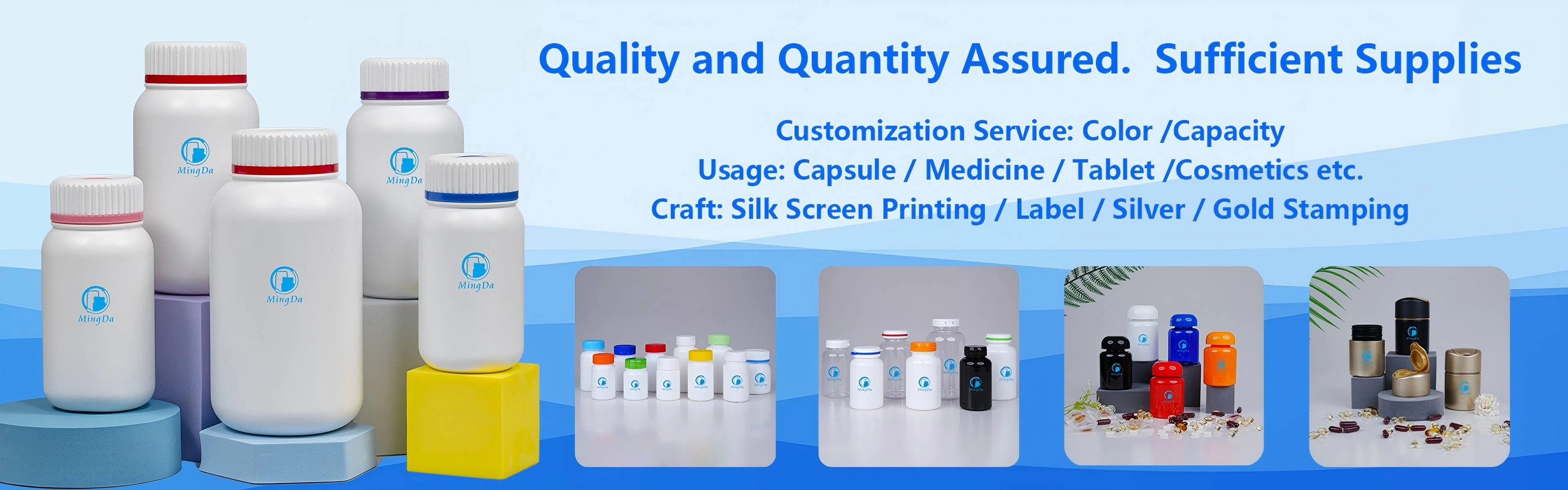
Mingda is a good example of a balanced, large-scale nutraceutical packaging manufacturer.
- Founded in 2006, relocated to Xianning, Hubei in 2012
- Plant area around 100,000 m²
- 400+ employees
- 202 production lines across HDPE, PET, and PP
- Output exceeds 2 million bottles per day
- 1,400+ existing molds
- Used for capsules, tablets, powders, gummies, and functional foods
- Certifications include ISO9001, ISO22000, FDA, SGS
- Products exported to 39 countries, serving 300+ pharma and nutraceutical clients
What stands out here is consistency. Sealing performance, batch stability, and delivery schedules tend to stay predictable, which matters far more than small price differences over time.
2. Pearl River Delta Food-Grade Packaging Factories
Factories in southern China are often very fast to communicate.
Strong at PET high-clarity round bottles
Good for pilot projects and early-stage launches
Responsive during sampling and revisions
The trade-off: buyers should always double-check food-contact documentation before scaling volume.
3. East China Standardized Producers (Zhejiang / Jiangsu)
These factories usually come from a strong food-packaging background.
Stable quality and structured processes
Best for long-term repeat orders with fixed specs
Less flexible when it comes to non-standard customization
They work well once a product has already stabilized.
4. OEM / ODM-Oriented Custom Manufacturers
These suppliers focus on differentiation rather than volume alone.
Integrated bottle, color, and closure development
Suitable for brand-driven nutraceutical companies
Requires early planning for tooling cost and lead time
5. Sustainability-Focused Manufacturers
Some factories now specialize in PCR and recyclable materials.
PCR PET and HDPE round bottles
Fits sustainability-focused branding
Slightly higher cost and varying market acceptance
Useful when sustainability is a core brand message, not just a checkbox.
Choosing Between HDPE and PET for Nutraceutical Bottles
HDPE round bottles
Opaque or semi-opaque
Strong chemical stability
Common for tablets, powders, minerals
Most widely used material in nutraceutical packaging


PET round bottles
High transparency
Popular for softgels and liquid supplements
Good barrier properties, moderate heat resistance
My rule is simple: decide based on product stability first, then appearance-not the other way around.
Six Practical Tips I Give Buyers Again and Again
Do not judge suppliers by unit price alone. Batch consistency matters more long term.
Test samples under real conditions-torque, sealing, drop tests, and temperature storage.
Match the sealing solution carefully to powders, capsules, or liquids.
Existing molds reduce risk and shorten timelines.
Make sure capacity matches your sales forecast, especially during peak seasons.
For export markets, confirm compliance documents early to avoid last-minute rework.
These points come from real sourcing situations, not theory.
Final Thoughts
Choosing a round plastic bottle manufacturer for nutraceutical products in China is not a one-time decision. It shapes product stability, delivery timelines, and long-term supply reliability.
A careful evaluation at the beginning usually saves far more time and cost than switching suppliers later. If you are comparing factories or planning a new supplement launch, this framework should give you a clearer starting point.